B2B Ecommerce Website Development: The Comprehensive Guide for 2025
What is B2B Ecommerce Website Development?
B2B ecommerce website development is all about building online platforms where businesses can buy and sell products or services to each other. These platforms are designed to handle big orders and make it easy for companies to customize products or services to fit their clients’ needs. Plus, they often have secure approval workflows to streamline the buying process while keeping data safe. By using the right tech and design, B2B ecommerce sites can boost efficiency, strengthen business relationships, and help companies grow in a competitive market.
B2B vs. B2C Ecommerce: Key Differences
Target Customer:
B2B: The target audience consists of professionals and organizations.
B2C: The target audience includes individual end-users.
Purchase Decision:
B2B: The purchase decision involves multiple stakeholders and is primarily based on the organization’s needs, return on investment (ROI), and productivity improvements.
B2C: In B2C, the decision is made solely by the individual, focusing on personal preferences, tastes, needs, and wants.
Sales Cycle:
B2B: The sales cycle is longer and more complex due to the involvement of higher authorities, multiple stakeholders, and negotiations.
B2C: The sales cycle is straightforward and often leads to immediate decisions.
Pricing:
B2B: Pricing depends on order volume, contract duration, and typically involves large orders due to business purchases.
B2C: Pricing is generally lower as it caters to individual purchases. It varies based on the buyer’s budget, standard pricing, and frequent sales or promotions.
Customer Relationship:
B2B: The focus is on building long-term relationships between professionals, which includes regular updates and support related to purchases.
B2C: Customer relationships are shorter, centered around transactions. However, efforts to build brand awareness and customer loyalty remain essential.
Website Design:
B2B: B2B websites are designed for professional purposes with a logical buying process, accommodating longer sales cycles and higher costs.
B2C: B2C websites prioritize attracting and converting individual consumers by creating easy-to-navigate, visually appealing sites that foster emotional connections for an enhanced shopping experience.
The Evolution of B2B Ecommerce
Inspired by the consumerization of B2C e-commerce, business buyers began to seek user-friendly, personalized experiences akin to those enjoyed by consumers. The transition from slow phone and fax orders to automated digital platforms has ushered in a new era of B2B commerce. This evolution is aimed at streamlining transactions and expanding into global markets more efficiently. Additionally, businesses are leveraging data analytics to drive growth, foster deeper customer relationships, and respond more agilely to market demands than ever before. Triggered by the rise of Amazon Business and the impact of the pandemic, modern B2B e-commerce now emphasizes self-service portals, omnichannel integration, AI-driven personalization, and robust platforms built on flexible, composable architectures.
Essential Features of a Successful B2B Ecommerce Website
User Management and Role-Based Access
For managing complex corporate purchasing processes, robust user management and role-based access are essential for a successful E-commerce platform for B2B companies. Hierarchical accounts, custom roles like administrators and purchasing managers with spending limits, and personalized experiences with customer-specific catalogs and pricing comes under this feature.
Custom Pricing and Account-Specific Catalogs
In B2B relationships, which are often contract-based, features like custom pricing, account-specific catalogs, tiered discounts, and restricted product views are essential. These features help prevent pricing errors and streamline the buying process.
Advanced Search and Filtering
B2B e-commerce websites offer advanced search and filtering features, such as intelligent search that recognizes typos and synonyms, dynamic filtering, and the ability to filter by technical specifications. By implementing these advanced search capabilities, businesses can enhance user experience, reduce frustrations, and increase conversion rates
Streamlined Checkout and Reordering
For repeat business, quick reordering features are essential. Users should be able to reorder with one click, save custom templates, upload bulk orders via CSV, and manage multiple shopping lists. By focusing on these user-friendly functionalities, businesses can reduce manual effort, minimize errors, and enhance customer satisfaction and loyalty.
Quote Management and Approval Workflows
By providing automated tools for managing quotes and approvals, a B2B platform enhances operational efficiency, ensures compliance, and offers a transparent buying experience that fosters long-term customer relationships.
Key Elements of Effective B2B Web Design
User-Friendly Interface
The website’s structure should be logical, with clear and easy navigation as well as strong visual branding. By including features such as advanced search options, filtering capabilities, prominent calls to action, and a responsive design for seamless access across devices, a well-designed B2B interface can reduce user friction and enhance credibility.
Mobile Responsiveness
Seamless adaptation from desktop to mobile is crucial for enhancing user experience. The website structure modifies when viewed on mobile, as most buyers utilize mobile devices for research and purchasing decisions.
Professional Aesthetics
B2B platforms should be visually appealing yet professional. The color palette should align with the company’s business theme, and the combination should consist of no more than three shades.
Performance Optimization
A slow and inconsistent website negatively impacts user experience and can harm a business’s reputation, ultimately leading to lost revenue. Business buyers expect seamless, responsive, and straightforward navigation, as delays can reduce conversion rates and increase bounce rates.
Steps to Build a B2B Ecommerce Website
Step 1: Business Requirements Gathering
Step 2: Platform Selection and Planning
Step 3: Design and Development
Step 4: Testing and Quality Assurance
Step 5: Launch and Post-Launch Strategy
Current Trends in B2B Ecommerce Development
Headless Commerce Architecture
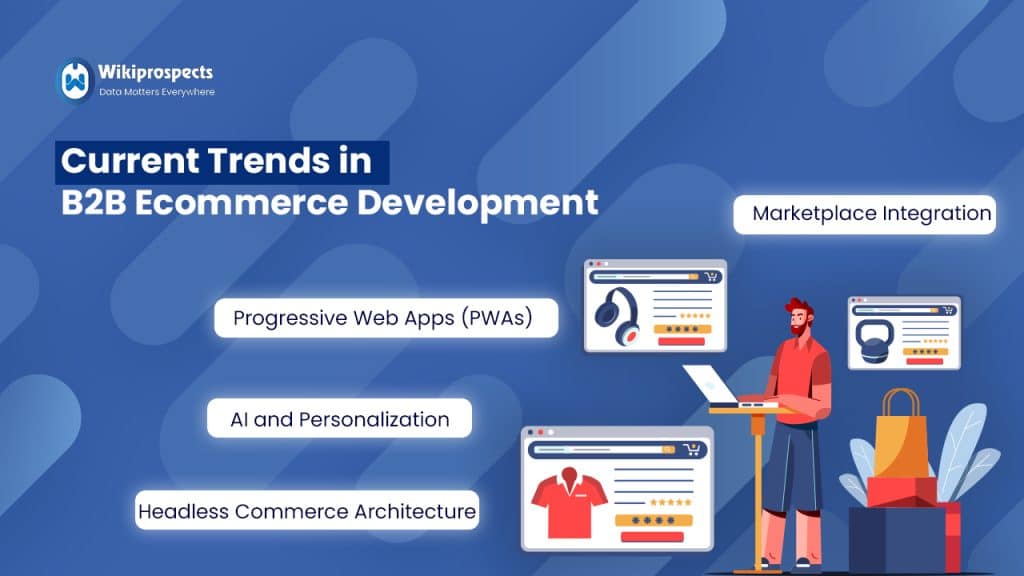
Headless commerce separates the front-end (customer interface) from the back-end (business logic) of an e-commerce platform using APIs. This decoupling allows businesses to quickly update the front-end and provides a consistent experience across various devices, such as websites, mobile apps, and kiosks..
AI and Personalization
By utilizing predictive analytics, AI enhances site search functionality, suggests personalized products, and customizes marketing content according to a buyer’s role, purchase history, and business context. Furthermore, AI-driven chatbots offer 24/7 customer support and deliver instant personalized assistance.
Progressive Web Apps (PWAs)
For B2B, PWAs enhance engagement and conversion rates by providing a fast, reliable mobile experience, simplifying deployment and maintenance with a single codebase, and boosting search engine discoverability.
Marketplace Integration
Businesses can broaden their audience by selling on third-party platforms such as Amazon Business or Alibaba. Alternatively, they can create their own first-party marketplace to host other vendors. This approach helps diversify sales channels, streamline inventory management, and provides access to valuable data analytics across different platforms.
Measuring Success: B2B Ecommerce KPIs
Key Performance Indicators for B2B Ecommerce
Revenue and Profitability:
- CLV (Customer Lifetime value) : Total revenue expected from a customer over their relationship.
- AOV(Average Order Value) : Average amount spent per order.
- MRR(Monthly Recurring Revenue) : Predictable monthly income from subscriptions.
- Profit Margin: Revenue minus cost of goods sold.
Acquisition and Sales:
- Lead-to-Customer Conversion: Percentage of leads that become customers.
- SQLs ( Sales-Qualified Leads) : Prospects vetted by sales and likely to buy.
- CAC ( Customer Acquisition Cost) : Cost to acquire one new customer.
- Quote-to-Cash Time: Time from quote to final payment.
Customer Engagement and Retention:
- CRR (Customer Retention rate) and Churn Rate: Rate of customer retention versus loss.
- NPS (Net Promoter Score) : Measure of customer loyalty and satisfaction.
- Repeat Purchase Rate: Percentage of customers who make additional purchases.
Operational Efficiency:
- Inventory Turnover: Rate at which inventory is sold.
- Order Fulfillment Rate: Efficiency of processing and delivering orders.
- Touchless Order Rate: Percentage of orders needing zero human intervention.
Analytics and Improvement:
- Use tools like Google Analytics and BI dashboards for tracking.
- Employ A/B testing and act on feedback to continuously improve performance.
Analytics and Reporting Tools
Powerful analytics tools are needed to track, interpret, and report on these B2B-specific metrics. Tool such as :
- Web Analytics (Google Analytics 4, Adobe Analytics)
- Business Intelligence (BI) Tools (Tableau, Power BI)
- User Behavior Tools (Hotjar, Contentsquare)
- Marketing Automation and CRM (HubSpot, Salesforce Pardot)
- Specialized E-commerce Analytics (Sana Commerce Insights)
Continuous Improvement Strategies
Use web analytics, user feedback tools, and A/B testing to identify friction points and make incremental, measurable improvements to the website’s functionality and user experience.
Prioritize self-service options and integrate backend systems like ERP and CRM to break down data silos, automate workflows, and increase operational efficiency.
Leverage insights from KPIs and reporting tools to inform strategic decisions, personalize the buyer’s journey, and drive ongoing optimization that boosts engagement, retention, and revenue.
Common Challenges in B2B Ecommerce Development

Complex Pricing and Product Configurations
The biggest challenge is dealing with complicated pricing and product setups when it comes to bulk orders, contracts, and custom technical requests. Juggling different pricing models like tiered rates, volume pricing, and negotiated deals while keeping everything consistent across all sales channels requires some pretty advanced automation and strong backend systems.
Legacy System Integration
Integrating older systems in B2B e-commerce is challenging because many businesses rely on outdated systems for inventory, ERP, and customer info. These old systems often don’t work with modern cloud technology, leading to data silos, higher maintenance costs, and slowed innovation.
User Adoption and Change Management
Integrating user adoption and change management into B2B e-commerce is crucial. Unlike B2C, success isn’t guaranteed just by launching a platform. The main challenge is helping sales teams and loyal customers shift from manual processes to a new digital system, focusing on the people involved in the change.
Conclusion: Building a Future-Proof B2B Ecommerce Website
A future-proof B2B eCommerce website can be developed with advanced features, such as headless commerce for flexibility, AI for personalized experiences, and streamlined user management for B2B transactions. After the development phase, it is crucial to manage complex pricing and continuously improve the site based on key performance indicators (KPIs). This ongoing effort is essential for B2B companies to stay competitive in today’s modern landscape.